Category Archives: Blog

Taking Care of Your Scar

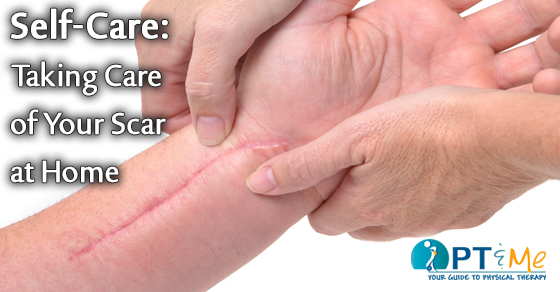
Self-Care: Taking Care of Your Scar at Home

ScarCare_FBsize

Taking care of your scar well is an important aspect of your recovery from surgery. You must follow your surgeon’s order faithfully.This includes keeping it dry and covered as long as your doctor tells you it is necessary. If your scar becomes excessively red or painful, notify your doctor or therapist.

scar

When you doctor tells you it is safe, you will need to start treating your scar at home. This is important because excessive scarring can lead to restricted movement and pain. The best approach to controlling your scar formation is to use your hands to free up skin around your scar. Rubbing Vitamin E oil or cocoa butter into your hands before massaging will also help your skin heal.

This information about taking care of your scar was written by Plymouth Physical Therapy Specialists, an outpatient physical therapy group with fourteen locations in the surrounding Plymouth, Michigan area. At Plymouth Physical Therapy Specialists, they are committed to using evidence-based treatments in their practice. This means that their therapists utilize the most current and clinically relevant treatments in their approach to rehabilitation. For more information click here.

McKenzie Method

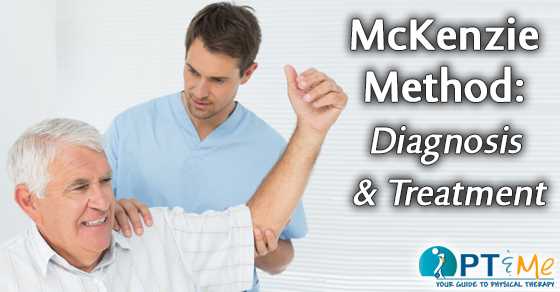
McKenzie Method: Diagnosis & Treatment

McKenzieMethod_FBsize

MECHANICAL DIAGNOSIS PHASE:
This system is based on the symptomatic and mechanical responses of patients to various repeated movements or static loading forces(that is a mechanical evaluation). It allows the classification of patients into broad, rather than tissue-specific, categories and thus leads to the formulation of treatment. Rather than seeking to make a diagnosis, which is the identification of a disease by the means of its signs and symptoms, The McKenzie system concentrates on syndrome identification. A syndrome is a characteristic group of symptoms and pattern responses characteristic of a particular problem. The system is now widely used to classify and treat patients with mechanical disorders.

PHYSICAL EXAMINATION PHASE:
• Explanation of problem to patient and reason for required exercise program
• Time scale
• The appropriate loading strategy, or strategies needed to manage the condition demonstrated to and practiced by the patient.
• The repetitions and regularity of exercise program explained to patient
• The expected pain response explained to patient

knee stretch

ASSESMENT PHASE:
• Symptomatic diagnosis
• Mechanical Diagnosis

PATIENT MANAGEMENT PHASE:
• Patient education component of management
• Information about the problem itself
• What patients can do to help themselves
• Information about tests, diagnosis and interventions
• Active Mechanical Therapy component:
• The specific exercises should be demonstrated to the patients, they should practice these, the expected pain response should be explained, as well as any warnings against lasting aggravation of their condition and as necessary progressions and alterations should be given.

This information was written by Hamilton Physical Therapy Services, L.P., an outpatient physical therapy group with five locations in Mercer County, New Jersey since 1978. Their modern state-of-the-art facilities are equipped to offer patients an excellent opportunity to reach their optimal functional abilities. Managed and operated by physical therapists mandates that patient care is our number one priority. For more information click here.

PT News

This Month in PT News. Featuring articles from PTandMe partnering clinics!


2. Coping with a Mysterious Pain Syndrome
Written by the Therapy Team at the Jackson Clinics – Middleburg, VA

As its name suggests, complex regional pain syndrome (CRPS) is a complicated and painful condition. Approximately 80,000 Americans are diagnosed with CRPS each year, usually in the arm, hand, leg or foot. Read more

3. Is Something Better than Nothing? 
Written by Erin Clason at the Center for Physical Rehabilitation – Grand Rapids, MI

When it comes to strength training, the answer is a resounding “Yes!” Most of us are aware of the benefits of strength training in areas like everyday physical function, bone rebuilding, self-confidence, fat reduction, and elevated metabolism. Read more

November 2016 Events

EVENTS_11-2016_FBsize

Check out our Physical Therapy Monthly Events Calendar! Focusing on events from PTandMe.com participating physical and occupational therapy clinics. Read more to find out what’s happening in your community in November 2016!

GEORGIA PHYSICAL THERAPY EVENTS

GREENSBORO, GA
DATE: November 9th 2016, 12:00PM – 2:00PM
8th Annual Thanksgiving Dinner
CLINIC: Advance Rehabilitation Physical Therapy – Greenboro
Advance Rehab is celebrating its 8th annual Thanksgiving dinner in Greensboro, Georgia with a turkey and all the fixings!
For more information about Advance Rehabilitation Physical Therapy, visit them online at http://www.advancerehab.com.

bladder control during pregnancy

Bladder Control During Pregnancy

BladderControlDuringPregnancy_FBsize

Aside from a growing belly, you may notice other changes in your body now that you are pregnant. One thing you may notice is the loss of urine when you are not trying to urinate. Loss of bladder control, also called incontinence, is common during pregnancy and after childbirth. Needing to run to the bathroom often or leaking urine can make you feel embarrassed. Do not feel shy about asking for physical therapy for incontinence. They can help you understand and manage bladder control, and make sure there are not other conditions causing your incontinence. Here is some information to help you learn more.

HOW DOES THE BLADDER WORK?
Urine is stored in your bladder, which is an organ located in the pelvis. The muscles of the pelvis help keep your bladder in place. When you urinate, urine travels from your bladder and out of your body through a tube called the urethra. Ring-like muscles (sphincter muscles) keep the urethra closed so urine does not pass until you are ready to urinate. Muscles at the end of the urethra (sphincter muscles) and in the pelvic floor also help to hold back urine.

HOW CAN BEING PREGNANT CAUSE BLADDER CONTROL PROBLEMS?
The weight of a baby in your belly and the act of giving birth will put pressure on your bladder and may cause your pelvic muscles to stretch and weaken. This causes your bladder to sag, and your urethra to stretch. Nerves can also be damaged. It is this damage to muscles and nerves that can cause bladder control problems to persist.

pregnant woman

HOW CAN I CONTROL MY BLADDER?
The good news is that incontinence may go away once your pelvic muscles heal, usually 6 weeks or so after giving birth. But you can take steps after childbirth to minimize bladder control problems by doing exercises to strengthen your pelvic floor muscles. Kegel exercises are one type of pelvic floor muscle exercise.

Kegel exercises do not require equipment and can be done anywhere—while sitting at your desk, standing in line at the bank, or even lying down in bed. They are done by squeezing your sphincter muscles in the same way you would when stopping urine flow. After 6-8 weeks of doing the exercises, you may find that you have fewer leaks.

Talk to your doctor to learn more about how to correctly do Kegel exercises. Following pregnancy, if Kegel exercises do not control the incontinence, your doctor may discuss other treatments or refer you to a specialist who can help.

Here are some general steps for doing Kegel exercises from the American Pregnancy Association:

• Squeeze your pelvic floor muscles as if you were trying to stop the flow of urine. Do not squeeze the muscles in your belly, legs, or buttocks.
• Hold for 5-10 seconds, then relax.
• Repeat 10-20 times.
• Try to do at least 3 sets per day.

If incontinence is still bothersome, talk to your doctor about other options, such as wearing absorbent pads or briefs. With support from your healthcare team, you will be able to manage incontinence, as well as other bodily changes that come with pregnancy.

by Marjorie Montemayor-Quellenberg, MA

RESOURCES:
American Congress of Obstetricians and Gynecologists
http://www.acog.org

Office on Women’s Health
http://www.womenshealth.gov

CANADIAN RESOURCES:
Health Canada
http://www.hc-sc.gc.ca

Women’s Health Matters
http://www.womenshealthmatters.ca

REFERENCES:
Kegel exercises. American Pregnancy Association website. Available at: http://americanpregnancy.org/labor-and-birth/kegel-exercises. Updated Aug. 2015. Accessed Feb. 10, 2016.

Treatments of common complaints in pregnant women. EBSCO DynaMed website. Available at: http://www.ebscohost.com/dynamed. Updated February 1, 2016. Accessed February 10, 2016.

Urinary incontinence fact sheet. Office on Women’s Health website. Available at: http://www.womenshealth.gov/publications/our-publications/fact-sheet/urinary-incontinence.html. Updated July 16, 2012. Accessed February 10, 2016.

Urinary incontinence in women. EBSCO DynaMed website. Available at: http://www.ebscohost.com/dynamed. Updated December 9, 2015. Accessed February 10, 2016.

What I need to know about bladder control for women. National Institute of Diabetes and Digestive and Kidney Diseases website. Available at: http://www.niddk.nih.gov/health-information/health-topics/urologic-disease/urinary-incontinence-women/Pages/ez.aspx. Updated June 2012. Accessed February 10, 2016.

3/5/2013 DynaMed’s Systematic Literature Surveillance: http://www.ebscohost.com/dynamed: Boyle R, Hay-Smith EJ, Cody JD, et al. Pelvic floor muscle training for prevention and treatment of urinary and faecal incontinence in antenatal and postnatal women. Cochrane Database Syst Rev. 2012;10:CD007471.

Last reviewed February 2016 by Michael Woods, MD Last Updated: 2/10/2016

EBSCO Information Services is fully accredited by URAC. URAC is an independent, nonprofit health care accrediting organization dedicated to promoting health care quality through accreditation, certification and commendation.

at the gym

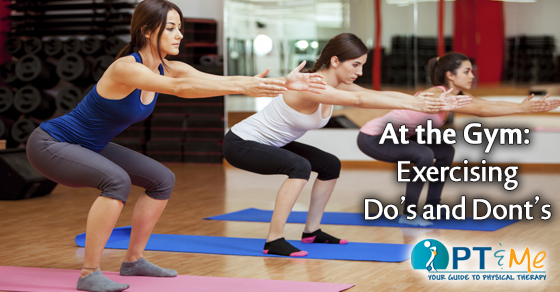
At the Gym: Exercising Do’s and Dont’s

AtTheGym#2_FBsize

In the second installment of our “At The Gym” exercise series we examine the proper ways to exercise at the gym from start to finish. If you have any sudden significant increase in pain, swelling, or discoloration while performing or following exercise, discontinue immediately and contact your therapist at your next therapy session.

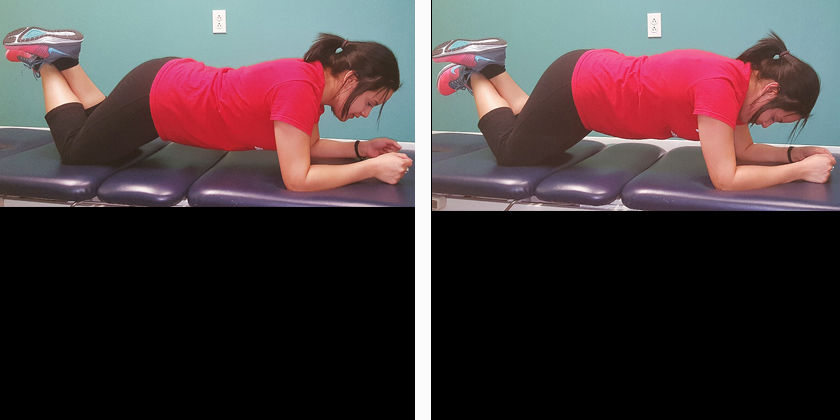
Plus Push Up 1

PLUS PUSH-UP

START POSITION
• Get on elbows and knees.
• Knees bent
• Straight or neutral back done by drawing the stomach in and the buttocks down.

ENDING POSITION
Push elbows into mat while trying to increase the space between the shoulder blades (round out your back between the shoulders).DON’T

DON’T
• Drop the head.
• Raise the buttocks or let the low back excessively curve inward.

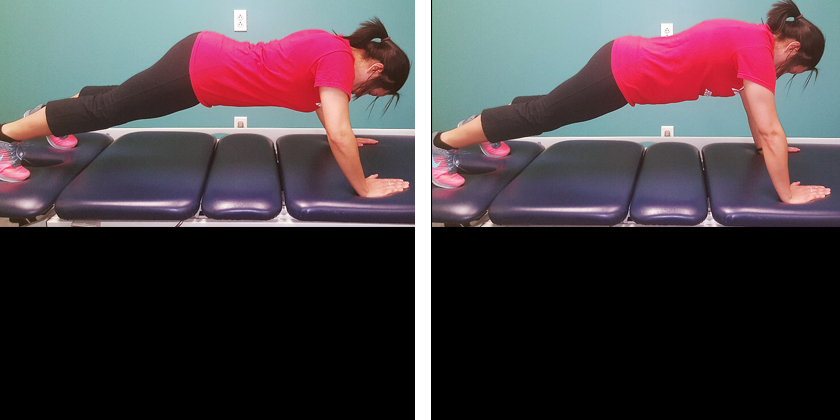
Plus Push Up 2

PLUS PUSH-UP: STAGE 2

START POSITION
Push-up position

ENDING POSITION
• Push hands into mat while trying to increase the space between shoulder blades.
• Rounded upper back appearance.

DON’T
• Drop the head.
• Raise the buttocks or let the low back excessively curve inward.

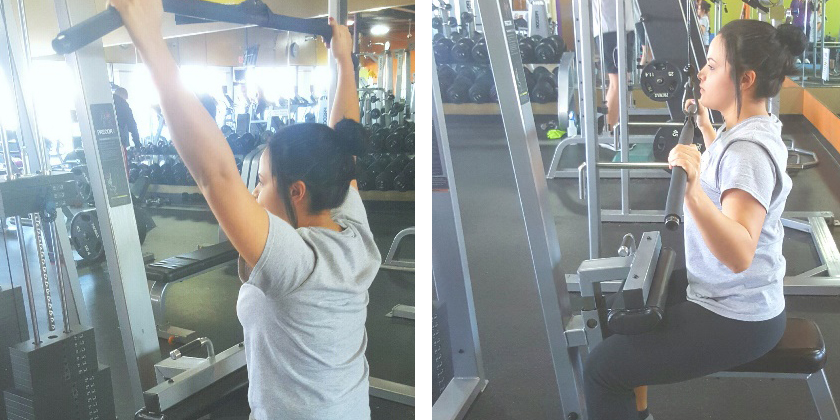
Scapular Depression

SCAPULAR DEPRESSION

START POSITION
• Seated with shoulder blades drawn downward (don’t shrug shoulders).
• Hands hold just outside of the curvature of the bar to comfort.
• Knees bent underneath knee pad and feet on the floor.
• Keep your back straight with a slight posterior lean from the hips.

ENDING POSITION
Bring bar to chest with elbows bent.

DON’T
• Lift feet off the ground.
• Rock at the waist.
• Elevate or let shoulders pull forward.
• Hyperextend the low back as you pull in.

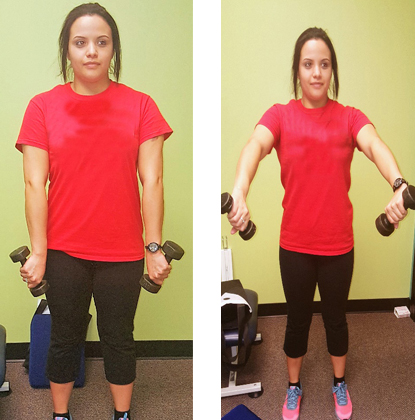
Empty Can 1

EMPTY CAN

START POSITION
Standing with hands at your side and thumbs pointing downward with feet shoulder width apart.

ENDING POSITION
Arms raised to about 60⁰ with thumbs facing down and slightly to your side.

DON’T
• Swing body back and forth.
• Shrug shoulders.
• Lift above 60⁰.

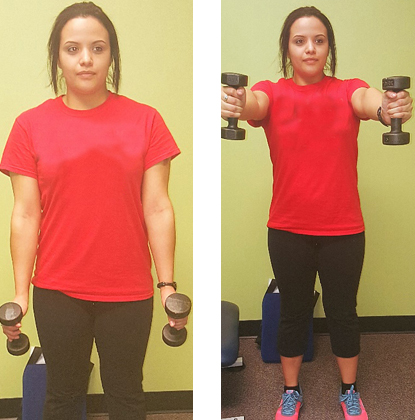
Full Can
FULL CAN

START POSITION
Standing with hands in front of you with thumbs pointing upward and feet shoulder width apart.

ENDING POSITION
Arms raised to 90 – 120⁰ with thumbs facing up.

DON’T
• Swing body back and forth.
• Shrug shoulders.
• Lift above 120⁰.

This information was written by STAR Therapy Services, an outpatient physical therapy group with six locations in Houston, Texas. At Star Houston Therapy Services, their number one priority is the patient. They strive to provide individualized treatment with hands-on, compassionate care. They perform comprehensive evaluations and encourage patient input for treatment planning and goal setting. For more information click here.

View the complete Exercising Do’s and Don’ts series below:


exercising do's and dont's

what to expect from physical therapy

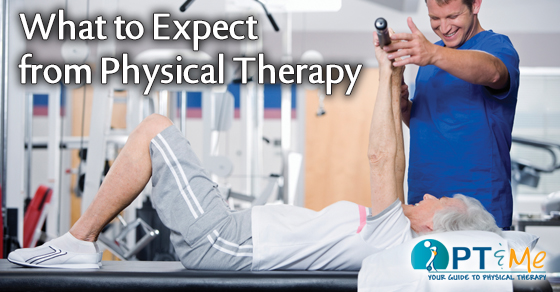
What to Expect from Physical Therapy

What_to_Expect_from_PT_FBsize

PHYSICAL THERAPY IS INTENDED TO MAKE CHANGES WITHIN YOUR BODY

We will accomplish this in several different ways. First, through the use of manual therapies, such as massage and mobilization of the joints. The goals of change are to:

  • Stretch short tissues to make them longer.
  • Strengthen weak tissues to make them stronger.
  • Improve and correct bad/abnormal biomechanics and asymmetries to alleviate pain and take the stress off the body.

THERE ARE SEVERAL THINGS THAT WE EXPECT DURING THE PHYSICAL THERAPY PROCESS, ESPECIALLY IN THE EARLY STAGES OF PT

  • You can expect that you will be sore after the first visit, and most likely the first 2 – 3 weeks until their body gets adapted to PT. Your body is just not used to doing the things that we are going to ask it to do, so there will be a period of adjustment.
  • The pain WILL move. As we make changes to your tissues and mechanics, the stresses on your body will change, thus altering where you will feel the pain or your symptoms.
  • The pain WILL change in terms of intensity, meaning that your pain is expected to fluctuate along the 10 point scale, starting between your high and low levels and changing based on your position, activity, and stress on the body.
  • The pain may also change in terms of the quality of pain. The pain may be: sharp, dull, achy, throbbing, burning, tingling, numbing.
  • It is important to know that all of the aforementioned statements are completely normal. There is nothing that you will experience that will surprise us. Everything that you experience will be normal. Even if what you feel is not normal to you, it is normal for your condition and what your body is experiencing.
  • Physical therapy is not an overnight miracle. Improvement takes time. It is important to understand that no one gets better every day from day one until they leave. Everyone will have good and bad days. In the beginning, you will have more bad days than good. As time progresses, this ratio should flip-flop and you should be having more good days than bad.

If you are looking for a physical therapist, we have you covered with over 500 locations nationwide!

physical therapy near me


This article was written by Life Fitness Physical Therapy, an outpatient physical therapy group with fourteen locations in the surrounding Baltimore, Maryland area. Life Fitness Physical Therapy is focused on improving the quality of life for their patients. They strive to provide individualized, evidence-based care that meets every patient’s unique needs. Their objective for each patient is to restore their function, achieve their goals and have them resume an active lifestyle as quickly as possible. For more information click here.

PT Month

Physical Therapy: Treating the Cause, Not Just the Symptoms of Pain

PT_treating the Cause of Pain_FBsize

This PT Month, instead of using prescribed pain killers, try physical therapy first.

WHY YOU SHOULD CHOOSE PHYSICAL THERAPY OVER PRESCRIPTION PAIN KILLERS
Physical therapy treats the cause of pain, more often than not leaving patients stronger and more able to enjoy life and function fully. In stark contrast, pain relievers treat only the symptoms – and can leave patients dependent or addicted.

drugs

PHYSICAL THERAPY IS THE SMART ALTERNATIVE TO OPIOIDS
More than 40 people die every day from overdoses involving prescription opioids. At least half of opioid overdose deaths involve a prescription opioid.

Wishing everyone a wonderful PT Month!

Information provided by the Center for Disease Control and Prevention. To learn more about the CDC click here.

PT News

This Month in PT News. Featuring articles from PTandMe partnering clinics!

car reverse

2. Going in Reverse: When Your Back Impedes Driving
Written by the Therapy Team at the Jackson Clinics – Middleburg, VA

When backing up your car, do you find it difficult to turn around to see what’s behind? Loss of rotational ability in the back is one of the problems we develop as we age. Read more

man stretching 2

3. 4 Ways To Improve Your Quality of Life Today
Written by the Therapy Team at Momentum Physical Therapy – San Antonio, TX

How often do you get home tired from a long day, frustrated with work, traffic, or co-workers? Our blood pressure has increased, stress levels have caused emotional, behavioral, and physical changes in us that otherwise would not be part of our normal calm day. Read more

October 2016 Events

EVENTS_10-2016_FBsize

Check out our Physical Therapy Monthly Events Calendar! Focusing on events from PTandMe.com participating physical and occupational therapy clinics. Read more to find out what’s happening in your community in October 2016!

GEORGIA PHYSICAL THERAPY EVENTS

FOLKSTON, GA
DATE: October 21st 2016, 5:00PM – 7:00PM
20 Year Anniversary Cookout
CLINIC: Advance Rehabilitation Physical Therapy – Folkston
Advance Rehab is celebrating its 20 year anniversary in Folkston, Georgia with a cookout and live music by local artist Justen Harden
For more information about Advance Rehabilitation Physical Therapy, visit them online at http://www.advancerehab.com.

IDAHO PHYSICAL THERAPY EVENTS

BOISE, ID
DATE: October 18th – 15th 2016
2016 NPI Annual Fall Conference
CLINIC: Intermountain Physical Therapy & Hand Rehabilitation – Boise
Intermountain will have a booth at this year’s event. Stop on by and see how physical therapy brings patients back to their full potential! For more information about Intermountain Physical Therapy & Hand Rehabilitation, visit them online at http://www.intermountainpt.com.

MICHIGAN PHYSICAL THERAPY EVENTS

MONROE, MI
DATE: October 4th 2016, 3:00PM – 6:00PM
Monroe Open House
CLINIC: Advanced Physical Therapy – Monroe
Advanced Physical Therapy’s Monroe clinic is celebrating their relocation with an open house! Join us for snacks, drinks and check out the new digs. We’d love to have you as we get to know our new neighbors and friends! First 100 guests will receive a free gift. For more information about Advanced Physical Therapy, visit them online at http://advphysicaltherapy.com.

NEW JERSEY PHYSICAL THERAPY EVENTS

BORDENTOWN, NJ
DATE: October 17th 2016, 4:30PM – 8:00PM
Work Comp Seminar at Villa Mannino Restaurant
CLINIC: Hamilton Physical Therapy Services, L.P.
Attention all work comp case managers and adjusters! Join Hamilton Physical Therapy and Princeton Brain & Spine Care as they talk about the Evaluation and Rehabilitation of Concussions in the injured workers.

AGENDA:
4:30 pm – 5:30 pm — Registration & Vendor Exhibit
5:30 pm – 5:45 pm — Opening Remarks
5:45 pm – 7:30 pm — Clinical Presentation
7:30 pm – 8:00 pm — Q&A Session

For more information contact Jaime Caceres at Hamilton Physical Therapy Services in Hamilton, New Jersey at (609) 585-2333. Also, visit Hamilton Physical Therapy Services online at http://www.hamiltonphysicaltherapy.org.

TENNESSEE PHYSICAL THERAPY EVENTS

NASHVILLE, TN
DATE: October 15th 2016, 8:00AM – 11:00PM
2016 – 2017 Heart Walk at Vanderbilt University Sport Field
CLINIC: STAR Physical Therapy
Help STAR Physical Therapy reach their goal to raise $5,000 for the American Heart Association. You can help us by donating to our team ($20 donations receive a custom t-shirt) or join the STAR Physical Therapy Heart Walk Team and join us at the event! For more information about STAR Physical Therapy, visit them online at http://www.starpt.com.

TEXAS PHYSICAL THERAPY EVENTS

CLEVELAND, TX
DATE: October 15th 2016, 9:00AM
Walk with a Doc for Hardhats & Little Heads
CLINIC: Cleveland Physical & Occupational Therapy
Cleveland Physical & Occupational Therapy is participating in this year’s Walk With A Doc at the Cleveland High School Track! Bring your friends and family to enjoy a day of fun! Participants will walk on the track with national award winning doctor Dr. Sulaiman, explore vendor booths, receive health and community information as well as meet local fireman and police officers all while getting healthy! Special appearances by Reggie Airman Dixon, Maurice Termite Watkins, and Reggie Johnson. Children will be provided with free bikes, helmets, t-shirts, water bottles, goodie bags and more as part of the Hard Helmets for Little Heads initiative while supplies last. All materials will be distributed on a first come, first served basis. For more information, please contact Kimberly Hughes at (281) 592.2224 – ext. 206 or at khughes@hcset.com. You can also visit the official event website here: http://walkwithadoc.org/our-locations/cleveland-texas/. For more information about Cleveland Physical & Occupational Therapy, visit them online at http://www.clevelandpt.com.

WISCONSIN PHYSICAL THERAPY EVENTS

JEFFERSON, WI
DATE: October 10th 2016, 5:30PM – 6:30PM
JUMP: Great Apple Crunch Fun Run
CLINIC: Sport & Spine Physical Therapy – Jefferson
Sport & Spine Physical Therapy in Jefferson, Wisconsin invites Jefferson community members of all ages to join us in our 4th annual one mile FUN RUN/WALK! Participation ribbons for all children
There will also be refreshments. In the event of inclement weather, it will be canceled with no make-up date. For more information contact Jo Christianson at christiansonj@tds.net.
Also, please visit Sport & Spine Physical Therapy online at http://sportandspineclinic.com.
MERRILL, WI
DATE: October 8th 2016, 8:00AM – 1:00PM
2016 Leaf Pile Run 6th Annual 5k Run/Walk & 1k Kids Run
CLINICS: Sport & Spine Physical Therapy & Merrill Physical Therapy
Please join Sport & Spine Physical Therapy, Merrill Physical Therapy and other WVAM members for a fun and festive fall run, to help support Wisconsin Valley Athletic Medicine by participating in the 2016 Leaf Pile Annual Event. All 5k and 1k participants receive a complimentary wristband for same day entry to Helene’s Hilltop Orchard to enjoy a hayride, corn maze, cow train, and the play area. Complimentary beverages from Red Eye Brewing Co. and root beer from Central Beer Distributors. Need more info? Contact Andy at Sport & Spine Clinic at adavis@usphclinic.com or call (715) 693-7727. For more information about Merrill Physical Therapy, visit them online at http://www.merrillpt.com.