Category Archives: Blog

exercise at the gym

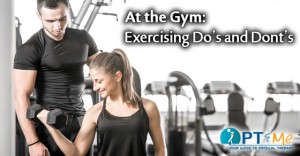
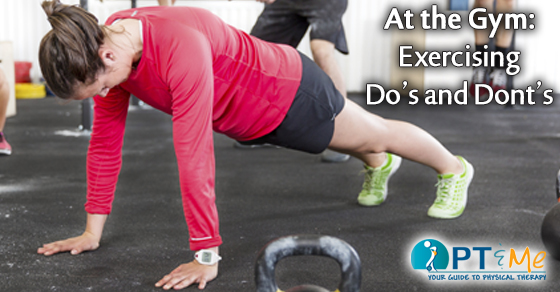
At the Gym: Exercising Do’s and Don’ts

AtTheGym#1_FBsize

In this new monthly series we examine the proper ways to exercise at the gym from start to finish. If you have any sudden significant increase in pain, swelling, or discoloration while performing or following exercise, discontinue immediately and contact your therapist at your next therapy session.

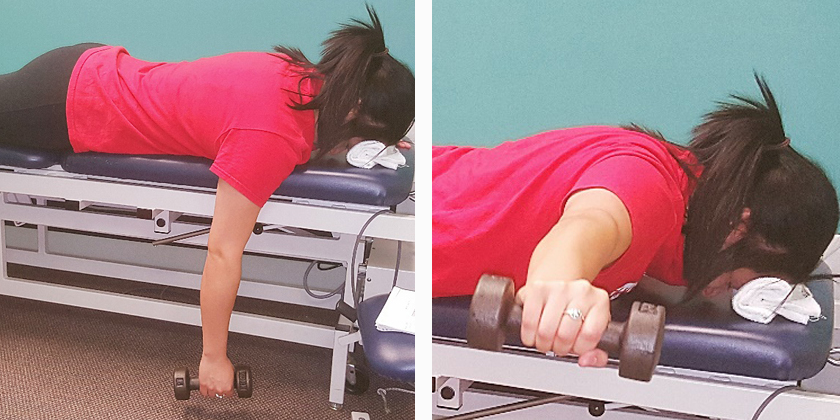
Scapular Strengthening

SCAPULAR STRENGTHENING

START POSITION
• Lay face down on the edge of the bench with arm hanging downward
• Rolled towel under forehead for support

ENDING POSITION
Arm raised straight to your side no higher than the torso with palms facing down

DON’T
• Arch your back when lifting dumbbell
• Lay with face turned sideways
• Raise the dumbbell too high

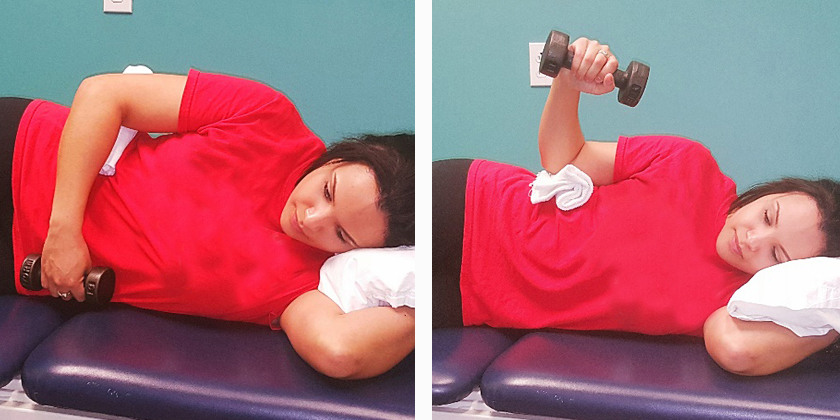
External Rotation Side Lying

EXTERNAL ROTATION – SIDE LYING

START POSITION
• Side lying with elbow at 90⁰ bend
• Support the head and rolled towel under arm holding dumbbell

ENDING POSITION
Side lying with external rotation at the shoulder until you feel an anatomical stop at the shoulder (about 45⁰); keep elbow bent

DON’T
• Create rotation at the torso
• Don’t raise the arm from the towel

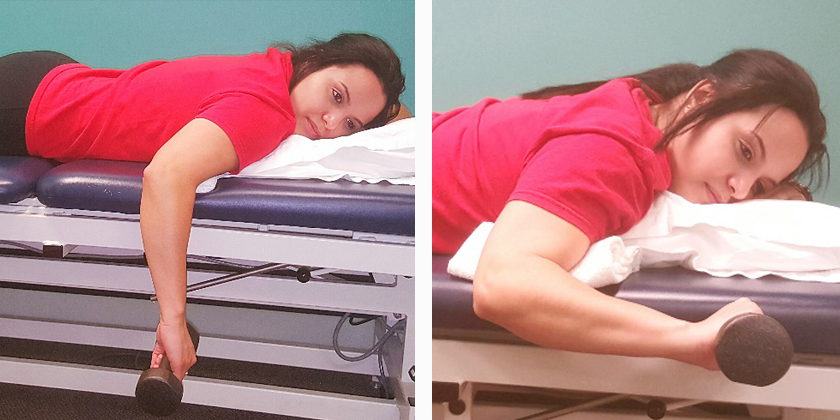
External Rotation Prone

EXTERNAL ROTATION – PRONE

START POSITION
• Lay face down with head facing to the side
• Forearm hanging off table with elbow bent to 90⁰
• Bicep is on the bench and supported by a towel

ENDING POSITION
About 45⁰ of external rotation

DON’T
• Externally rotate past 45⁰
• Raise arm from the towel

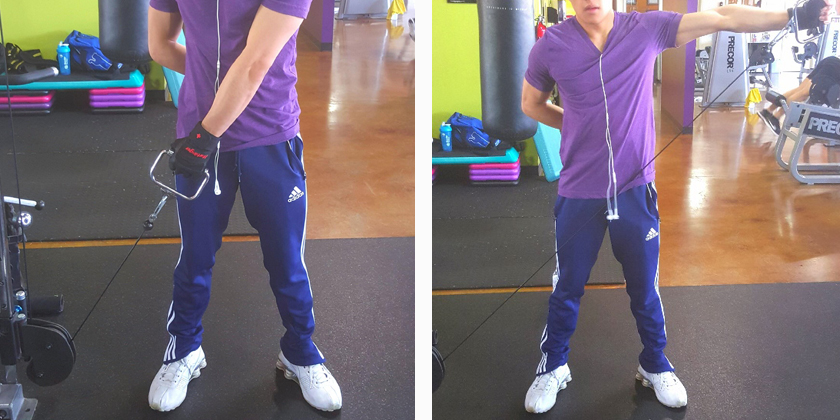
D2 Flexion

D2 FLEXION

START POSITION
• Standing with feet shoulder width apart
• Hold handle with arm crossing body to opposite side
• Palm facing body.

ENDING POSITION
• Arm raised slightly above the shoulder (about 120⁰ which is slightly higher than shown) with thumb facing upward
• Creating a “disco” motion

DON’T
• Let thumb face sideways or downward at end of exercise
• Lean backwards or sideways to assist in exercise
• Shrug shoulders

This information about how to exercise at the gym was written by STAR Therapy Services, an outpatient physical therapy group with six locations in Houston, Texas. At Star Houston Therapy Services, their number one priority is the patient. They strive to provide individualized treatment with hands-on, compassionate care. They perform comprehensive evaluations and encourage patient input for treatment planning and goal setting. For more information click here.

View the complete Exercising Do’s and Don’ts series below:


exercising do's and dont's

Protect, Stretch & Rest: General Tips

ProtectStretchRest_FBsize

These are some general healthy tips to remember during your day-to-day activities.

• If you are doing strenuous, household or outdoor work protect your hands with gloves in order to prevent injury and/or loss of moisture.
• Take frequent breaks or switch to a new activity. Overuse of repetitive motions, such as pressing buttons, can cause tendonitis of the elbow or lead to Carpal Tunnel Syndrome.
• If you find yourself sitting at your computer for hours each day, stop each hour and stretch your fingers, arms and the rest of your body to help prevent injury to your bones, joints and muscles.
• If you have pain during your activity, stop. Pain is one of the ways your body is letting you know that you are overextending a particular muscle group.

Physical Therapy Day

World Physical Therapy Day

WorldPTDay_FBsize

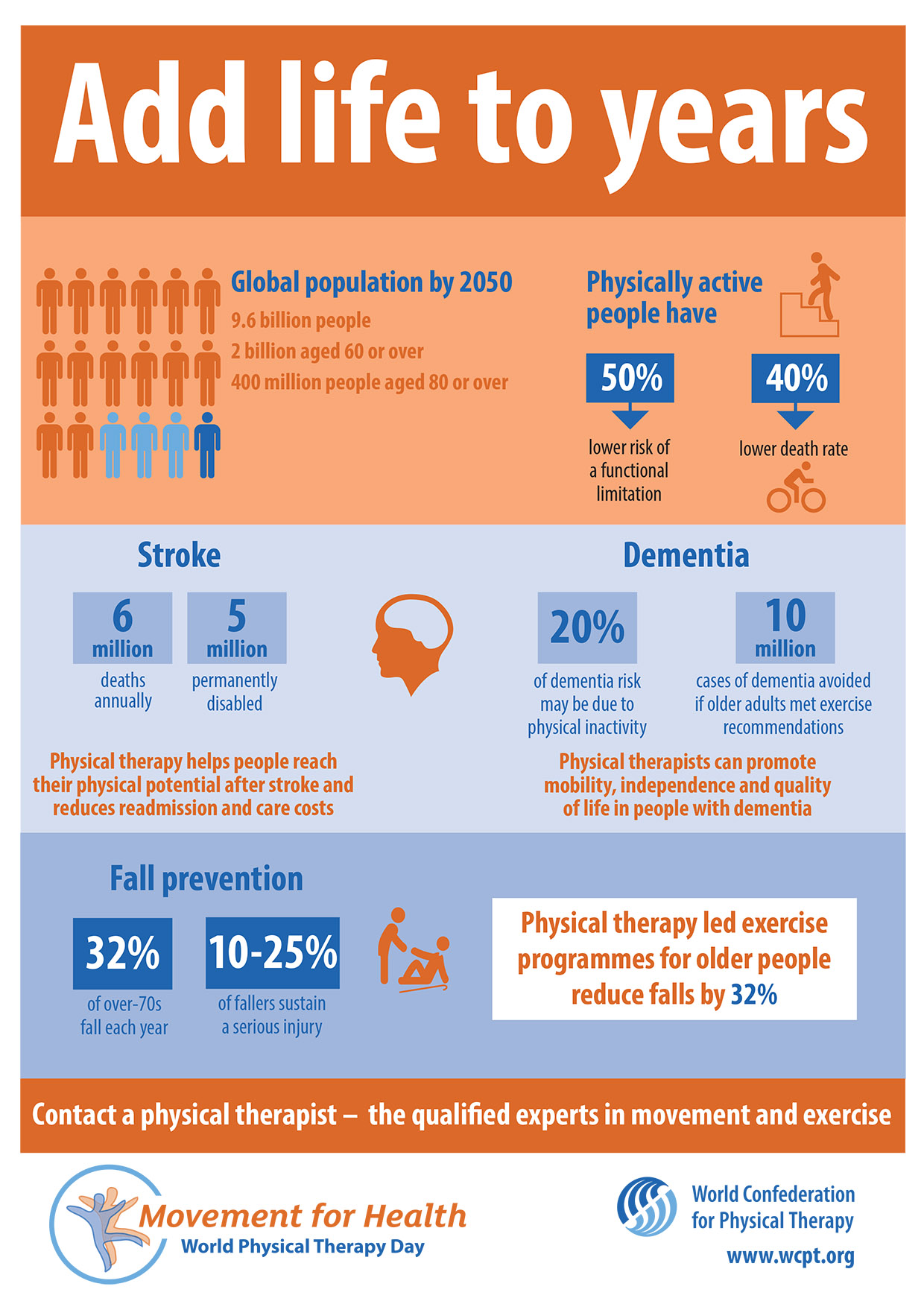
World Physical Therapy Day is on September 8th. The day is an opportunity for physical therapists from all over the world to raise awareness about the crucial contribution the profession makes to keeping people well, mobile and independent. This year the focus is on adding years to your life by being physically active! See how a little bit of movement can go a long way!

WPTD2016_infographic_A4_FINAL

To  learn more about World Physical Therapy Day click here.

bone health

Exercise and Bone Health

ExerciseBoneHealth_FBsize

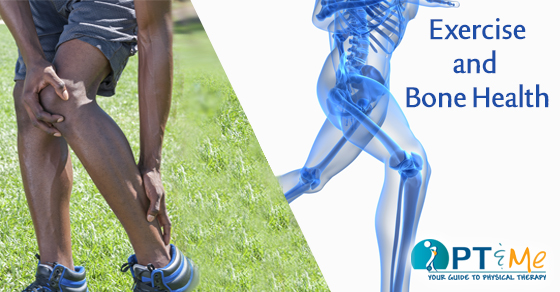
Bone is living tissue that is constantly undergoing a process called remodeling. In remodeling, cells called osteoclasts are breaking down old bone, as cells called osteoblasts are replacing it with new tissue. Many factors can affect the remodeling process and leave you with bones that are less dense and more fragile.

Some factors that interfere with bone health and remodeling are:
• Increased age
• Low vitamin D—The body makes vitamin D in response to sunlight. You can also get vitamin D by eating certain kinds of food or by taking a supplement.
• A diet low in calcium
• Smoking
• Lack of exercise—especially weight bearing and resistance exercise

Why Exercise Is Good for Bone Health
Regular weight-bearing and resistance exercise helps build muscle, as well as maintain and increase bone strength. Exercise causes the muscle to contract against the bone. This action stresses or stimulates the bone, and the bone becomes stronger and denser. The 3 main types of exercise are (some activities can be more than 1 type):

Aerobic (Cardiovascular) Exercises to Improve Bone Health
In aerobic exercise, you continually move large muscles in the legs, shoulders, and buttocks. This action causes you to breathe more deeply, and your heart to work harder pumping blood, thereby strengthening your heart and lungs. Examples include:
• Walking
• Jogging
• Running
• Aerobic dance
• Bicycling
• Swimming

Weight-Bearing Exercises to Improve Bone Health
In weight-bearing exercises, your bones and muscles work against gravity, and your feet and legs bear the weight. Your bones adapt to the weight and pull of the muscle during weight-bearing exercise. Examples of weight-bearing exercises include:
• Jogging
• Walking
• Stair climbing
• Dancing
• Soccer

Resistance Exercises to Improve Bone Health (Strength Training)
Resistance exercises use muscle strength to improve muscle mass and strengthen bone. Examples include:
• Weight lifting, using:
• Free weights
• Weight machines
• Elastic tubing

• Calisthenics such as push-ups and chin-ups

tennis guy

Tips for Beginning:
Aerobic or Weight-bearing Exercises to Improve Bone Health
• Warm up for 5 minutes before activity. This can consist of dynamic stretches that involve movement and a light walk.
• Start the activity slowly for the first 5 minutes.
• Slowly increase your intensity so that your heart rate increases. A person doing moderate-intensity aerobic activity can talk. A person doing vigorous-intensity activity cannot say more than a few words without stopping to take a breath.
• Gradually increase your workout until you are working out at least 150 minutes a week at moderate–intensity or 75 minutes a week at vigorous intensity.

Resistance Exercises to Improve Bone Health
• Begin each exercise with light weights and minimal repetitions.
• Slowly (over weeks) increase weight, never adding more than 10% in a given workout.
• Do these exercises 2-3 times a week. Allow for 1 day between each workout for your bones and muscles to rest and repair themselves.
• Gradually increase the number of repetitions to 2-3 sets of 8-10 repetitions with a rest period of 30-60 seconds between sets.
• Although stiffness the day after exercise is normal, if you are in pain, you did too much. Decrease the intensity or the duration of your exercise.

Before starting any type of exercise program, check with your doctor about any possible medical problems you may have that could limit your ability to exercise.

by Mary Calvagna, MS

RESOURCES:
National Osteoporosis Foundation
http://www.nof.org

The President’s Council on Physical Fitness, Sports, and Nutrition
http://www.fitness.gov

CANADIAN RESOURCES:
Canadian Orthopaedic Foundation
http://www.canorth.org

Public Health Agency of Canada
http://www.phac-aspc.gc.ca

REFERENCES:
2008 Physical Activity Guidelines for Americans. US Department of Health and Human Services website. Available at: http://www.health.gov/paguidelines/guidelines/default.aspx#toc. Published October 2008. Accessed January 21, 2016.

Bone remodeling. University of Washington website. Available at: http://courses.washington.edu/bonephys/physremod.html. Updated March 30, 2007. Accessed January 21, 2016.

How much physical activity do adults need? Centers for Disease Control and Prevention website. Available at: http://www.cdc.gov/physicalactivity/everyone/guidelines/adults.html. Updated June 4, 2015. Accessed January 21, 2016.

Osteoporosis. EBSCO DynaMed website. Available at: http://www.ebscohost.com/dynamed. Updated October 13, 2015. Accessed January 21, 2016.

Skeleton keys. Smithsonian Museum of Natural History website. Available at: http://anthropology.si.edu/writteninbone/young_old.html. Accessed January 21, 2016.

Last reviewed January 2016 by Michael Woods, MD

EBSCO Information Services is fully accredited by URAC. URAC is an independent, nonprofit health care accrediting organization dedicated to promoting health care quality through accreditation, certification and commendation.

September 2016 Events

EVENTS_09-2016_FBsize

Check out our Physical Therapy Monthly Events Calendar! Focusing on events from PTandMe.com participating physical and occupational therapy clinics. Read more to find out what’s happening in your community in September 2016!

FLORIDA PHYSICAL THERAPY EVENTS

JUPITER, FL
DATE: September 22nd 2016, 10:00AM – 3:00PM
Healthfair Event for G4S Employees
CLINIC: Comprehensive Hand and Physical Therapy – Jupiter
Comprehensive Hand and Physical Therapy will be participating in this year’s Healthfair for GS4 Employees. Stop by our booth and meet our talented therapists and ask us questions about any aches or pains that you may be experiencing. We can’t wait to see you there! For more information about Comprehensive Hand and Physical Therapy, visit them online at http://www.comprehensivehandandpt.com.


MARYLAND PHYSICAL THERAPY EVENTS

OCEAN CITY, MD
DATE: September 18th – 21st 2016, 9:00AM – 12:00PM
MWCEA 2016 Workers’ Compensation Conference
CLINIC: Agape Physical Therapy
Agape Physical Therapy will be exhibiting at the MWCEA 2016 WC Conference. Make sure to stop by their booth to see what great services Agape Physical Therapy provides to local businesses and workers’ compensation professionals. For more information about Agape Physical Therapy, visit them online at http://www.agapept.com.


MICHIGAN PHYSICAL THERAPY EVENTS

GRAND RAPIDS, MI
DATE: September 22nd 2016, 4:00PM – 8:00PM
CPR Downtown Open House During Artprize!
CLINIC: The Center for Physical Rehabilitation – Downtown Grand Rapids
The Center for Physical Rehabilitation’s Downtown Clinic is hosting an open house during Artprize! Join us for food and fun. Come see our newest location and meet our talented staff. We can’t wait to see you there! For more information about The Center for Physical Rehabilitation, visit them online at http://www.pt-cpr.com.


TENNESSEE PHYSICAL THERAPY EVENTS

MANCHESTER, TN
DATE: September 3rd 2016, 8:00AM – 12:00PM
Manchester STAR Physical Therapy Triathlon
CLINIC: STAR Physical Therapy – Manchester
Join STAR Physical Therapy Manchester for their annual Manchester STAR Physical Therapy Triathlon. It includes a 200 Yard Swim, 14 Mile Bike and 5K Run

Packet pick up: Friday, September 2nd, 6:00AM – 7:30PM
Saturday, September 3rd, 6:00AM – 7:30AM
Pre race meeting: Saturday, September 3rd, 7:30AM

A portion of this years proceeds will be donated to Coffee County school back pack program for underprivileged children who are not getting adequate food after school. Tickets available at http://www.startriathlon.com. For more info about STAR Physical Therapy you can visit them online at http://www.starpt.com.


TEXAS PHYSICAL THERAPY EVENTS

IRVING, TX
DATE: September 16th – 17th 2016, 6:00AM – 6:00PM
Irving Main Street Event
CLINIC: Green Oaks Physical Therapy
Celebrating Irving’s ‘Hometown’ Feel.
This annual street festival in the heart of the Irving Heritage District celebrates the hometown feel of Irving with attractions for all ages. Each year thousands of people attend this family affair, which offers live music, the Manifolds on Main Street Car Show, free rides and activities for children, great food and shopping. Green Oaks Physical Therapy will have a booth set up with info about all of our clinics and the services we provide. We will also have fun giveaways!
For more info about Green Oaks Lake Physical Therapy you can visit them online at http://www.greenoakspt.com.


VIRGINIA PHYSICAL THERAPY EVENTS

CHRISTIANSBURG, VA
DATE: September 14th 2016, 12:00PM – 4:00PM
AARP – VCOM Health and Wellness Fair
CLINIC: University Physical Therapy – Christiansburg
University Physical Therapy will be exhibiting at the 2016 Health and Wellness Fair! Please stop by our clinic to see how physical therapy can make a difference in your life! For more info about University Physical Therapy you can visit them online at http://www.universityptonline.com.

PT News

This Month in PT News. Featuring articles from PTandMe partnering clinics!

basketball

1. How Does an NBA Player Overcome Career Limiting Ankle Injury?
Written by Nick Mezyk, DPT, Clinic Director at ProCare Physical Therapy – Johnstown, PA

If you have played sports long enough, you have most likely experienced the following… You’re running down the field, court or track, and you go to make a quick cut. Except you end up crumbling to the ground because you rolled your ankle causing a popping sensation on the outside portion of that ankle. Read more


gym guy

3. Top Equipment Free Exercises You Should Be Doing 
Written by the Therapy Team at Momentum Physical Therapy – San Antonio, TX

The idea of exercising always conjures up visions of personal trainers, expensive gyms, high-end equipment, and lots of grunting, groaning, and personal torture. That’s never the case when we use the term exercise. Read more

avoid pitching injuries

Physical Therapist Tips on Avoiding Injury to Your Throwing Arm & What to Do in Case You Do

PTTipsOnThrowing_FBsize

Throwing a baseball or softball is one of the most demanding motions on the human body in sports. For each throw, the athlete generates high levels of energy in the arm and body to accelerate the baseball and softball to a high velocity. Just as it is important to understand proper biomechanics to improve performance, it is important to understand the stresses placed on the throwing shoulder and elbow by the throwing process.

Physical Therapist Tips on how to avoid pitching injuries

• Teach young athletes to be mindful of how their bodies feel. Pain is the first sign of a problem, and athletes of all ages need to pay close attention to any type of muscle twinge, tightening, or burning sensation.

• Coaches should carefully observe their pitchers’ techniques. Success on the field may be fleeting if the pitches ultimately are damaging a young player’s shoulder.

• Conditioning and strengthening exercises are most effective after mechanics are learned and put into action. If possible, begin a conditioning program at least a month before the season begins. A basic stretching regimen should be used before a player ever picks up a baseball.

• Players should start with short tosses and gradually work up to throwing the ball a greater distance. Increasing the velocity should be the final step.

• If the arm region is sore or tight, apply ice to the area for 10-15 minutes to help diminish the amount of blood that might otherwise leak into the muscle. When there is microscopic tearing of the muscle tissue, blood is leaking into the surrounding muscular tissue, causing pain and muscle spasms. Using ice will help reduce the pain, spasms, and inflammation associated with this condition.

• Before age 10, only fast ball and change-up should be permitted.

This information about how to avoid pitching injuries was written by University Physical Therapy, an outpatient physical therapy group with eight locations in New River Valley, Virginia. University PT is THE choice for outstanding sports rehabilitation, physical therapy and occupational therapy services. For more information click here.

concussion

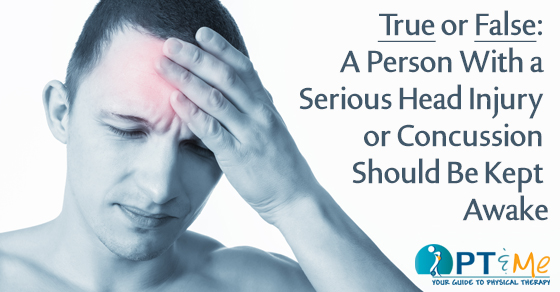
True or False: A Person With a Serious Head Injury or Concussion Should Be Kept Awake

TrueorFalse_FBsize

All head injuries should be treated seriously. While most won’t cause lasting effects, if improperly treated, they can lead to long-term disabilities or even death.

The most common type of head injury is a concussion. It is a jarring trauma to the brain that can cause a person to lose consciousness or have amnesia.

What do you do if you are around someone who experiences a serious head injury or concussion? You may have heard that you should not let the person go to sleep, but is this true? Most health professionals don’t think so. It is generally considered safe for people with head injuries or concussions to go to sleep. In some cases, a doctor may recommend waking the person regularly to make sure his or her condition has not worsened.

Evidence for the Health Claim
Many people will go to great lengths to keep a person who has had a head injury from falling asleep. They argue that keeping the person awake will decrease the risk that he or she slips into a coma.

This misunderstanding probably stems from hearing about a rare occurrence known as a lucid interval that has been associated with certain types of severe head injuries. A lucid interval occurs when the initial bleeding in the brain does not cause loss of consciousness. The bleeding eventually worsens and brain structures become compressed. The person’s condition can rapidly deteriorate, requiring emergency brain surgery.

Evidence Against the Health Claim

Most medical professionals say it is fine—sometimes even advised—to let people sleep after incurring a head injury.

The American Academy of Family Physicians states it is not necessary to keep a person awake after a head injury. If a person needs to be watched that closely, a doctor will most likely admit him or her to the hospital. The Dartmouth College of Sports Medicine advises that it is fine to go to sleep after a concussion so long as someone wakes you up every two hours. They are to check to make sure you can be easily awakened and aren’t displaying symptoms of a worsening condition.

In a study in the September-October 2005 issue of the Journal of Head Trauma Rehabilitation, researchers reported greater levels of fatigue in people who have had head injuries, compared with those who have not. The researchers concluded that regular rest breaks and increasing intervals of restful sleep should be a part of the rehabilitation from head injury.

neon concussion

Conclusion
If you are around someone who has a head injury or possible concussion, monitor the symptoms closely. It is important to call a doctor or go to a hospital immediately if the person has worrisome symptoms such as:
• Open wound in the scalp or misshapen deformity of the skull
• Severe or progressive worsening headache
• Changes in behavior (eg, confusion, restlessness, irritability, lethargy)
• Dilated pupils or pupils of different sizes
• Convulsions or seizures
• Difficulty waking from sleep
• Trouble walking or speaking
• Bleeding or drainage of fluids from nose or ears
• Unusual sleepiness or decreasing alertness
• Severe or persistent nausea, or vomiting more than twice
• Weakness or numbness in the arms or legs

When a head injury is serious enough to require medical care, a doctor will give you instructions on how to monitor and treat the injury once the person is released from the hospital or clinic. These instructions will generally not include keeping the person awake and alert.

by Krisha McCoy, MS

More PTandMe articles about concussions can be found here:

concussion physical therapy   concussion treatment


REFERENCES:
Head injuries. KidsHealth.org website. Available at: http://www.kidshealth.org/parent/firstaid_safe/emergencies/head_injury.html. Accessed November 5, 2008.

Head injuries: what to watch for afterward. Familydoctor.org website. Available at: http://familydoctor.org/084.xml. November 5, 2008.

Head injury: concussion. Dartmouth College of Sports Medicine website. Available at: http://www.dartmouth.edu/~sportmed/concussion.html. November 5, 2008.

Radiology for traumatic brain injury. Trauma.org website. Available at:http://www.trauma.org/neuro/neuroradiology.html. Accessed July 23, 2006.

Subjective reports of fatigue during early recovery from traumatic brain injury. Journal of Head Trauma Rehabilitation. 2005;20:416-425.

EBSCO Information Services is fully accredited by URAC. URAC is an independent, nonprofit health care accrediting organization dedicated to promoting health care quality through accreditation, certification and commendation.
Recovering from knee surgery

Self-Care: Safe Positions & Movement After Knee Surgery

SelfCareKneeSurgery_FBsize

ACTIVITY GUIDELINES
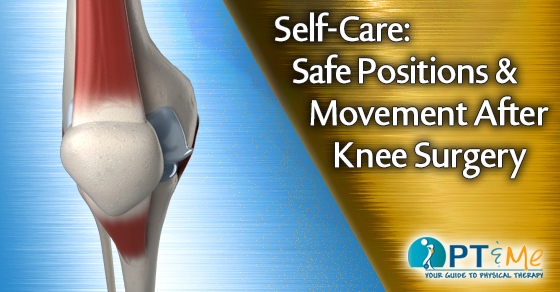
Recovering from knee surgery does not have to prevent you from moving or taking care of yourself. Listed below are guidelines on how to do some common movements and activities without hindering the healing process.

SLEEP & POSITIONING
• It is very important that when recovering from knee surgery you get enough rest following your surgery. If you cannot get comfortable in your bed, please talk to your therapist.
• Sleep on a bed with a firm mattress. Ideally, the bed should come up to your mid-thigh while you stand.
• Sleep flat on your back and position your leg so your toes and kneecaps point at the ceiling.
• Do not place pillows under your operative leg. If you wish to elevate your leg, support the whole leg with pillows while keeping the knee straight.

Sitting Up In Bed:
• If possible, get out of bed toward non-operated side so that the operated leg is supported as much as possible.

From Sitting on the Side of the Bed to Standing with the Walker:
• Straighten the operated leg in front of you before standing.
• Ensure you have good sitting balance with the walker close in front of you.
• Push up from the bed with both hands and keep weight on the non-operative leg.

From Standing to Getting Into Bed:
• Sit down on the edge of the bed; place at least one hand on the bed as you lower yourself. Remember to keep the operated leg further ahead to avoid straining it.
• Enter your bed leading with the operated side if possible.
• Bring your legs onto the bed while lowering your upper body with your hands then elbows.

BATHING/SHOWERING:
You may shower in a bathtub or shower stall only after your doctor has given their permission.

Getting Into the Tub to Take a Shower:
• Have the tub bench or tub chair placed in the direction facing your shower faucets.
• Using your walker, back up to the bench.
• Reach back with one hand to the bench and sit down with your legs outside of the tub.
• Place one leg at a time into the tub.

Getting Out of the Tub:
• While seated on the tub bench/chair turn your body and place your legs one at a time outside of the tub.
• Push up from the tub bench and stand using both hands on the walker.

knee brace

TOILET TRANSFERS:
When recovering from knee surgery the low surface may cause excessive painful bending at the knee. If this is the case, your therapist may help you with getting a raised toilet seat or a three-in-one commode that can be used over your toilet.

Getting Up and Down From a Toilet:
• Back up to the toilet.
• Reach back for the armrests/raised toilet seat/seat.
• Slide your operated leg slightly forward and lower yourself slowly onto the toilet.
• To stand, use a grab bar or place your hand at the middle of the center bar of the walker.
• Stand up and get your balance before placing both hands on the walker.

DRESSING:
• Put on your top or shirt as you normally would while seated.
• Do not twist the knee too much when dressing or putting on shoes.
• Your therapist may recommend a sock aid, dressing stick, reacher or long-handled shoe horn to help with dressing.

STAIRS:
You should only try to go up or down stairs when your doctor or therapist says it is okay. Do not try to use stairs while using a walker.
• When going up the steps, first step up with your non-operative leg, followed by the operative leg.
• When going down steps, first step down with your operative leg, followed by the non-operative leg.
• Complete only one step at a time and always have help.

CAR TRANSFERS:

While you are recovering from knee surgery you will need someone to help you with getting in and out of the car for both your safety and comfort. The seat would ideally be at the height of your mid thigh. Avoid cars with low or bucket seats.
• Have someone slide the seat back as far as possible prior to entering the car, preferably on the front passenger side.
• Slightly recline the seat back if possible.

Common Football Injuries

Common Football Injuries

CommonFootballInjuries_FBsize

Football is one of the most popular sports played by young athletes, and it leads all other sports in the number of injuries sustained. In 2007, more than 920,000 athletes under the age of 18 were treated in emergency rooms, doctors’ offices, and clinics for football-related injuries, according to the U.S. Consumer Product Safety Commission. Physical therapy can provide specific treatment to a number of specific football injuries. Here are a few injuries that can happen during a football game or practice:

KNEE INJURIES
Knee injuries in football are the most common, especially those to the anterior or posterior cruciate ligament (ACL/PCL) and to the menisci (cartilage of the knee). These knee injuries can adversely affect a player’s long-term involvement in the sport. Football players also have a higher chance of ankle sprains due to the surfaces played on and cutting motions.

Physical therapy treatment for knee injuries may include:
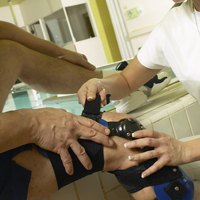
• Exercises to help promote recovery. Specifically, therapists will design a program to strengthen the whole leg as well improve its range of motion.
• Balance exercises to allow the return to daily activities (including work and sports) while decreasing the risk of falls and reinjury
• Hands-on treatment to keep the knee joint from becoming stiff
• Ice and vasopneumatic pressure to reduce swelling and pain

SHOULDER INJURIES
Shoulder injuries are also common. The labrum (cartilage bumper surrounding the socket part of the shoulder) is particularly susceptible to injury, especially in offensive and defensive linemen. In addition, injuries to the acromioclavicular joint (ACJ) or shoulder are commonly seen in football players.

Physical therapy treatment for shoulder injuries may include:
NON-SURGICAL
Most labral tears will respond well to non-surgical treatment and may be just one component of a multi-factored pathology of the aging shoulder. Physical therapy will typically address a labral tear from the biomechanical approach of improving the motion and reducing the repetitive injury. If the inflammation and mechanical stress on the structures can be reduced then the tissue has a chance to heal.
SURGICAL
If the athlete has had surgery to the shoulder, the therapist will follow a specific protocol to apply just the right amount of strain on the shoulder to keep it safe after surgery. A sling may be recommended in the early stages but the therapist will get the arm moving with assistance within a relatively short period of time. Physical therapists will give instructions on how to provide varying levels of assistance to the arm for motion in safe planes in front of the body, and eventually throughout the entire range of motion. Once the tissues are healed, the therapist will begin to put resistance on the support structures in order to improve the mechanics of motion and reduce the risk of another injury.
kid football player

CONCUSSIONS
Football players are very susceptible to concussions. A concussion is a change in mental state due to a traumatic impact. Not all those who suffer a concussion will lose consciousness. Some signs that a concussion has been sustained are headache, dizziness, nausea, loss of balance, drowsiness, numbness/tingling, difficulty concentrating, and blurry vision. The athlete should return to play only when clearance is granted by a health care professional. It is recommended that players go though a concussion baseline test before the start of the season. Results from baseline tests (or pre-injury tests) can be used and compared to a similar exam conducted by a healthcare professional during the season if an athlete has a suspected concussion. More information here.
Physical therapy treatment for concussions may include:
EVALUATION: The physical therapist will take time to talk with you and perform a thorough examination of your condition.
THERAPY: The physical therapist will plan a treatment program suited to your individual condition, which will involve exercises for your balance, vision, inner ear and more in order to restore brain function.
TEACHING: Physical therapists will spend time reviewing information with you regarding your diagnosis and progress as well as answering your questions. This empowers the patient to make a lifelong impact on their health.
RETURN TO SPORT: Physical therapists are uniquely qualified to guide you towards a safe return to sport. A therapist can guide recovering athletes through a stepwise protocol to keep patients symptom free,  and to prevent serious, life-threatening conditions associated with a second head injury due to early return to football.

OVERUSE INJURIES
Low-back pain, or back pain in general, is a fairly common complaint in football players due to overuse. Overuse can also lead to overtraining syndrome, when a player trains beyond the ability for the body to recover.

Physical therapy treatment for overuse injuries may include:
Pain-relieving techniques (such as ice) and decreasing or modifying painful activities. This diagnosis often occurs from muscular tightness or weakness which causes posture to get out of alignment. A physical therapist will educate and assist in proper stretching and strengthening exercises for the back. They may perform hands on, manual therapy techniques to further increase joint flexibility. The final phase of rehab will involve strengthening during functional activities and education to prevent the injury from recurring.

RESOURCES:
U.S. Consumer Product Safety Commission
www.cpsc.gov

Stop Sports Injuries
www.stopsportsinjuries.org

REFERENCES:
Preventing Football Injuries. http://www.stopsportsinjuries.org/STOP/Prevent_Injuries/Football_Skating_Injury_Prevention.aspx